Sunday, March 15, 2015

A learning platform for Chinese language - Twitter

Social media has become one of the best tools for sharing information and ideas. Teaching/learning Chinese has become much easier due to this tool. For example, many individuals or organisations share their ideas and experiences, producing quality programs to help people learn Chinese or teaching Chinese online. They may run it as a business or simply just as a hobby or with good intention. Regardless, they provide a broad range of learning tools, resources, information, links or experiences for Chinese language learners around the world. In order to promote Chinese language education, I am happy to spread their links. Of course, it’s up to you to explore.

 1.    ChineseSkill, The Most Effective #Chinese Learning App! Now available       in @AppStore and@GooglePlay. Completely Free,  https://twitter.com/ChineseSkill, Beijing, China

2. Hanzi WallChart, We make big old Chinese character posters and other cool stuff to learn Chinese with. Based in London, https://twitter.com/Hanzi_WallChart, London, UK

3. FluentU Chinese, We bring Chinese to life with real-world videos, https://twitter.com/FluentUChinese

4. Yoyo Chinese, Learn Chinese with Yangyang Cheng with short and fun video lessons, https://twitter.com/yoyochinese, Los Angeles, California, US

5. Remember.it.chinese, The fast & easy way with our remembr.it/chinese-charac andremembr.it/chinese vocabulary courses. Free Trial Available. https://twitter.com/richinese

Friday, December 26, 2014

A fantastic teaching resource: Transition 前进乐团 (Dui Bu Qi 对不起我的中文不好)

If you haven’t used this resource for your students, you should do it now. It’s very encouraging to see ‘外国人说中文although this song is called “我的中文不好”. They have not only learnt Chinese language, but also Chinese culture - 谦虚.


An excellent resource for developing students' intercultural understanding: What You Should NEVER Give to a Chinese Person

In order to help students develop their intercultural understanding, which is an essential skill in a globalised world, teachers need to encourage students to compare and contrast the target and their own cultures, to reflect on students’ own cultures, and to ‘create personal meanings about one’s experiences, communicate those meanings, explore those meanings and reshape them in response to others’ (Scarino & Liddicoat, 2009:23).  The following is an excellent resource for teachers to induce the discussion. 


Thursday, October 30, 2014

我爱中国菜 - I like Chinese food

我爱中国菜 - 非常Fresh

A great teaching resource to go with topics, such as  Eating & Drinking or Chinese food. Hope you enjoy it.

Thursday, August 21, 2014

You are invited to participate in the second Book Launch for Learn Chinese While Singing

If you missed the first Book Launch for Learn Chinese While Singing in June, this is another oppotunity for you to know the books. Please see the information below.


Dear Chinese Language Teacher,

You are cordially invited to join us to celebrate the publication of a wonderful new set of books bt Wei Leu.

'Learn Chinese While Singing'- by WEI LEU


This set of books is an excellent and welcome addition to the resources available to teachers for teaching Chinese!

"Singing makes you happy, whatever the language, but particularly in Chinese where, for a few carefree minutes you can forget all about those pesky tones and just sing!


And when students are happy, they’re more open to learning – which makes for happy teachers too".
- Gilly Hutchinson, Chinese Language Teacher


Book Launch:
at CHINA BOOKS SYDNEY

WHEN:
6.30PM, Friday, 29th August, 2014
WHERE: Shop F7, Level 1
683-689 George Street, SYDNEY
(just below the Marigold Restaurant)
RSVP: Georgina or Jayne on 9280 1885 for catering purposes.


Guest Speakers:

Dr Shuangyuan Shi:
Director of the Confucius Institute, NSW Department of Education and Communities
Feng Junying: Education Consul, The Consulate-General of P. R. China in Sydney

This is indeed another milestone for Chinese Language in schools and worth celebrating!

Refreshments will be provided!

Please see attachments for MORE DETAILS!!

Warmest Regards,
Georgina & Jayne
CHINA BOOKS SYDNEY


CHINA BOOKS Sydney specialises in publications (and products) about China and things Chinese. We are the only specialist source in Australia and New Zealand.

CHINA BOOKS (Sydney) Shop F7, First Floor, Citymark Building
683-689 George Street
Sydney NSW 2000

Phone: (02) 9280 1885
Fax: (02) 9280 1887
Email: info@ChinaBooksSydney.com.au
Web : www.ChinaBooksEducation.com.au

Saturday, July 12, 2014

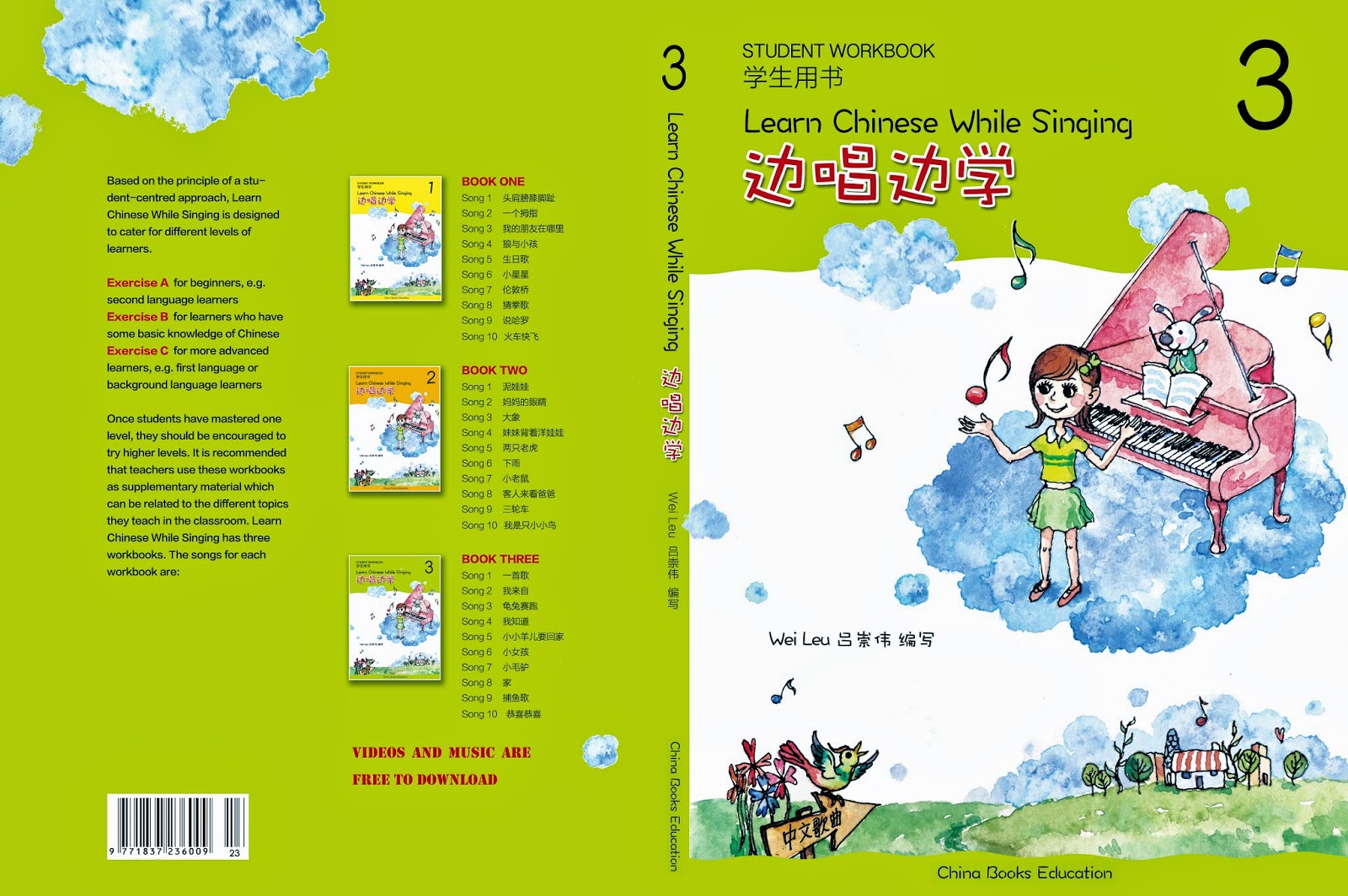
Learn Chinese While Singing Student Workbooks 1-3 (《边唱边学》学生用书1-3集) are on the market now

‘Incorporating songs into Chinese language teaching is challenging but very rewarding because students will be motivated to learn’


‘Well-chosen songs that clearly illustrate prescribed topics are an important part of an effective teaching and learning program’


Learn Chinese While Singing Student Workbook 1-3 met their readers for the first time in Sydney on 26th June, 2014. Around 60 teachers and guests attended our Book Launch on the day. As I said in an interview with SBS Radio, Learn Chinese While Singing is not only a book title, but also a belief – a new way of teaching Chinese. My experience of incorporating songs into Chinese language teaching has assured me that songs are excellent texts for teaching a language. Apart from being able to practise speaking (singing) and listening skills, lyrics of a song can be used for reading and writing purposes. Worksheets and tasks can be designed and produced for students to develop their reading and writing skills. Moreover, songs can be used for developing students’ grammatical capacity, intercultural understanding, and higher-order and critical thinking skills. For example:

1.      大象,大象,你的鼻子怎么那么”(The elephant, the elephant, how come your nose is so long - Book Two, Song 3). From this short text, a similar grammatical structure can be used for “你的头发怎么那么长你怎么那么聪明她怎么那么骄傲”.
 

2.      爸爸不在家,我请客人先坐下,再去倒杯茶” (Dad was not home. I invited the guest to sit down, and then went to pour a cup of tea - Book Two, Song 8). This is part of Chinese traditional culture emphasising politeness and manners. Students can develop their intercultural understanding by reflecting on their practice in their own cultures.


3.      小孩子乖乖,把门开开,快点开开,我要进来” (Little boy, be good. Open the door quickly. I want to come in - Book One, Song 4). For young primary children, this can be an opportunity to develop their critical thinking skills. Teachers may ask them: “Do you think you should open the door? Why not? Why yes?” Through this exercise and discussion, young children will have a chance to explore different answers and justifications.


In fact, Learn Chinese While Singing consists of three parts: videos of songs for teaching, music for recording students’ singing, and workbooks for students to develop their reading and writing skills. Teachers (or parents) are encouraged to use all three parts to engage their students (or children). All the videos and music can be accessed through the links on the left- hand side of this blog. Alternatively, teachers simply need to type in “Learn Chinese While Singing, Book 1(2 or 3)” or “边唱边学, Book 1 (2 or 3)” on YouTube, which will direct them to the videos. If you are interested in purchasing the workbooks, please contact:
1.     China Books (Sydney), (02) 92801885

Or
2.     China Books (Melbourne), (03) 96638822

Or
3.     learnchinesewhilesinging@gmail.com


Saturday, May 3, 2014

Learn Chinese While Singing Student Workbooks 1, 2 & 3 are coming《边唱边学》学生用书就要出版了


                                         敬请期待


Singing songs is one of the most effective ways of learning a language, especially for young children. Back in the ‘70s, when I was studying Spanish at university, I enjoyed learning it through singing songs. Since I started teaching Chinese in 1995, I have used many songs to supplement the topics that I teach in my class. I have used songs as an effective text to teach students from K to 12. Sometimes we may hear a complaint from language teachers saying that today’s children are not keen to sing songs in their language classes. This may be true for some students but, it has definitely not been my own experience.
 
The crucial point is WHAT and HOW a teacher teaches. If a teacher uses a ‘childish’ song for Year 9 or Year 11 students, it is, of course, quite likely that he/she will fail. If a teacher just randomly selects a song and starts to teach it without conducting any pre-activities or without relating to a topic, students may not be engaged.
 
The songs collected in these books are some well-known and popular Chinese children songs. They have simple words and lyrics so that they are easily sung. Singing songs can improve a student’s speaking and listening skills. In order to master reading and writing skills, students need to practise and complete the accompanying exercises.
 
Based on the principle of a student-centred approach, these workbooks are designed to cater for different levels of learners. There are three levels of exercises for each song (Exercise A, B and C). Exercise A is for the beginners, e.g. second language learners; Exercise B is for learners who have some basic knowledge of the target language; Exercise C, which is more challenging, is for more advanced learners, e.g. young newly-arrived migrants or background language learners. Teachers need to assign the exercise according to the language level of the particular student(s) and, of course, need to encourage them to undertake more challenging work once they have mastered each level.
 
It is recommended that teachers use these workbooks as supplementary material which can be related to the different topics they teach in the classroom. Topics related are suggested only. It is also suggested that teachers use the videos, accessible from this blog, to teach and the music, which can be downloaded from this blog, to record students’ singing.
 
For purchasing Learn Chinese While Singing Student Workbooks 1, 2 & 3, please contact:
 
 
              Or

      2.     China Books (Sydney), (02) 92801885 

Wednesday, April 23, 2014

Useful online teaching and learning materials - listening and reading (有用的教学资源)


There are abundant online teaching and learning materials. In a globalised and Internet-connected world, sharing and exchanging teaching and learning materials have become much easier. However, teachers need to decide which is useful and which is suitable for your students. I always believe that teachers are ‘match-makers’ and they need to provide the most suitable learning materials for their students. Here is one of the teaching resources that may be useful for you. Please link to: 罗格斯多媒体中文教学系统

Friday, November 22, 2013

An easy way to learn Chinese characters – Shao Lan Hsueh’s ideas

Do you think it’s hard to learn Chinese characters? Maybe…., but maybe because you didn’t get an inspiring teacher like Shao Lan Hsueh (薛晓岚)…. Let’s listen to what she says.

Monday, March 25, 2013

Professional development for members of the NSW Chinese Language Teachers Association (CLTA)

It’s fantastic to see NSW Chinese teachers starting to share and help each other. It’s about time to connect all Chinese teachers, whether they are teaching in public or private schools, in secondary or primary schools, from universities or community schools, we are all in the same boat, especially at this time, when the “Australia in the Asian Century” White Paper has just been published last October and the “National Curriculum: Languages-Chinese” is on the consultation stage. The more we work together, the stronger our voice will be.

In her famous report, Chinese Language Education in Australian Schools (2008), Jane Orton, identified the “intercultural difficulties as a significant problem in the quality of program delivery by L1 teachers”. She means that some native teachers do not know “how to relate to Australian school learners, colleagues and parents”. On the other hand, she also mentioned that L2 teachers’ “language proficiency level in almost all areas was often not at the desired level in phonological aspects, grammatical correctness and extent of vocabulary and characters”. I believe this is a fair and realistic assessment and it reminds me a saying that I heard years ago - you cannot be a master teacher until you are a master learner.

Executives of NSW CLTA have decided to keep initiating and organising PD for our members this year. These workshops will be run by experienced teachers and the venues will be chosen by presenters/organisers. Each workshop or meeting will be about 2 hours and the number of participants will be limited depending on the venue. Another round may be considered if there is a demand.


Actually, CLTA’s first mini-workshop has just taken place last Thursday (21/03/2013). The topic has been “Teaching HSC Chinese Beginners Stage 6 Course”. About 27 teachers participated in this mini-workshop. Ideas, experiences, resources and strategies have been shared and discussed. I hope this would be the start of more interaction and exchange processes. Although we were talking about HSC Chinese Beginners, I believe we should be able to apply the resources and strategies to other L2 learners or Beginners of other levels. As I have promised, I will upload my resources in my blog. You are always welcomed to access and download them.

1. Important words appeared in past HSC Chinese Beginners papers

2. Questions appeared in past HSC Chinese Beginners papers

Monday, January 14, 2013

Translate English names into Chinese

你想把你的英文名字翻成中文吗?这是一个很好的网站。试看看吧!


Do you want to translate your English names into Chinese? Here is an excellent website that can do the job for you. Please link to Translate English names into Chinese

Tuesday, November 20, 2012

Learn Chinese While Singing Pop Songs (边唱流行歌曲,边学中文) – An excellent website for learners of Chinese language

This is a wonderful website for students who want to learn Chinese by listening and singing songs. It provides the pinyin and English explanations for many Chinese pop songs. Type in Chinese or English to find the songs that you like to sing.  Have a try, you will love it. Link to: http://www.singchinesesongs.com/

Thursday, August 2, 2012

Incorporating Songs Into Chinese Language Teaching (利用中文歌曲教学)

Since the student workbooks Learn Chinese While Singing 1 and 2 (边唱边学) were published online, I have received many emails asking questions about how to teach the songs. Since then, I had conducted some workshops titled “Incorporating songs into Chinese language teaching” on different occasions, including one at the Chinese National Conference last year (2011). The response was very positive. On 13/06/12, I was invited by Jess McCulloch from Melbourne to present in the Hanyulaoshi Show.


Using songs to teach Chinese may be a positive experience, especially when teaching to young learners. However, some teachers find it hard to teach songs to Year 7-10 students. I don’t agree, since I have tried it for all levels and school years including Year 11 and 12 students, and it can work well. I think the key point is ‘What (songs) and How (to teach)’. Teachers need to understand their students’ needs and language abilities. At the same time, they need to know what they want to achieve, e.g. speaking, listening, reading, writing or cultural appreciation. In order to teach effectively, teachers need to conduct some pre-teaching or after-teaching activities. If you are interested in learning these strategies, please link to: