Saturday, May 3, 2014

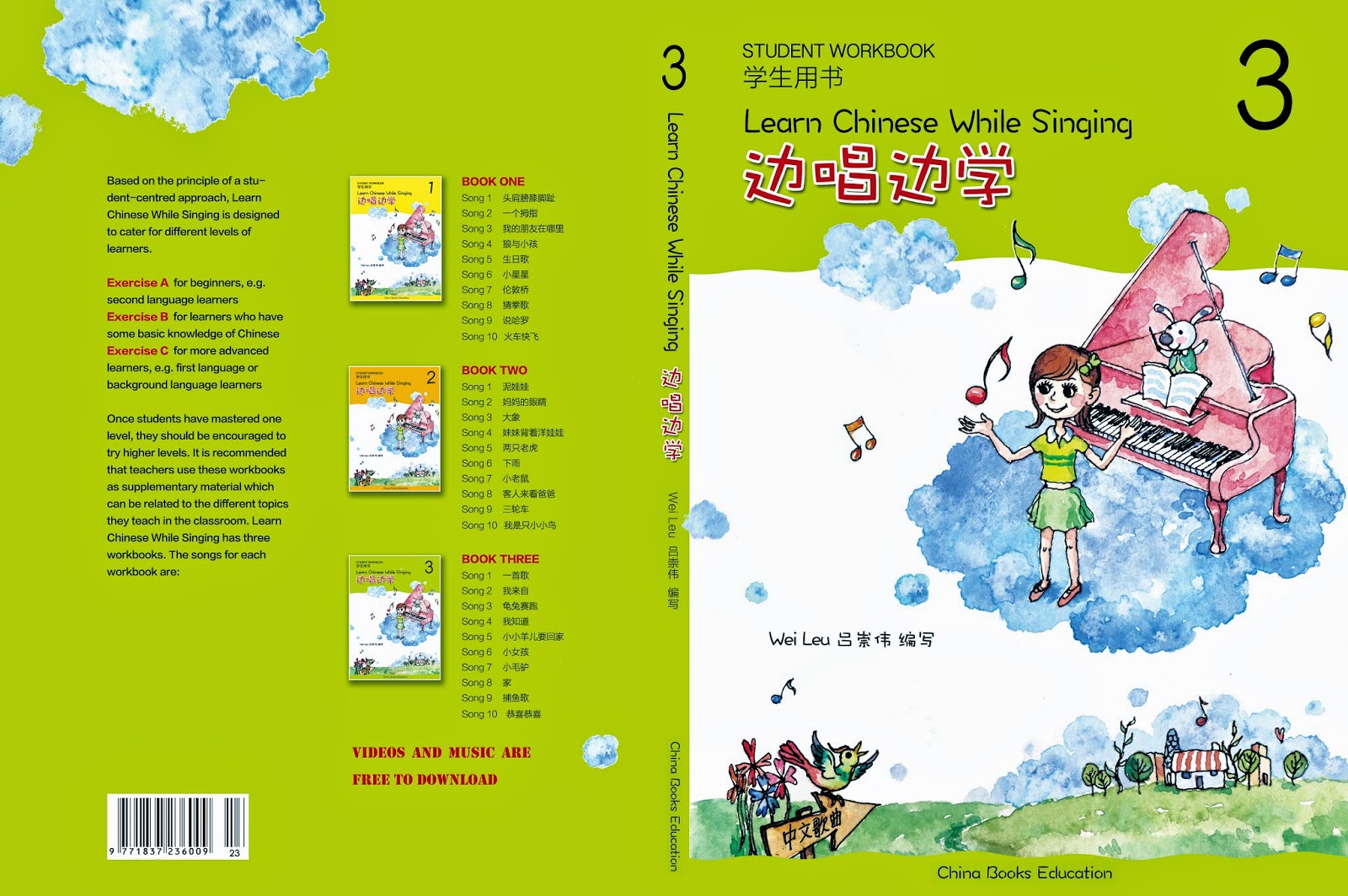
Learn Chinese While Singing Student Workbooks 1, 2 & 3 are coming《边唱边学》学生用书就要出版了


                                         敬请期待


Singing songs is one of the most effective ways of learning a language, especially for young children. Back in the ‘70s, when I was studying Spanish at university, I enjoyed learning it through singing songs. Since I started teaching Chinese in 1995, I have used many songs to supplement the topics that I teach in my class. I have used songs as an effective text to teach students from K to 12. Sometimes we may hear a complaint from language teachers saying that today’s children are not keen to sing songs in their language classes. This may be true for some students but, it has definitely not been my own experience.
 
The crucial point is WHAT and HOW a teacher teaches. If a teacher uses a ‘childish’ song for Year 9 or Year 11 students, it is, of course, quite likely that he/she will fail. If a teacher just randomly selects a song and starts to teach it without conducting any pre-activities or without relating to a topic, students may not be engaged.
 
The songs collected in these books are some well-known and popular Chinese children songs. They have simple words and lyrics so that they are easily sung. Singing songs can improve a student’s speaking and listening skills. In order to master reading and writing skills, students need to practise and complete the accompanying exercises.
 
Based on the principle of a student-centred approach, these workbooks are designed to cater for different levels of learners. There are three levels of exercises for each song (Exercise A, B and C). Exercise A is for the beginners, e.g. second language learners; Exercise B is for learners who have some basic knowledge of the target language; Exercise C, which is more challenging, is for more advanced learners, e.g. young newly-arrived migrants or background language learners. Teachers need to assign the exercise according to the language level of the particular student(s) and, of course, need to encourage them to undertake more challenging work once they have mastered each level.
 
It is recommended that teachers use these workbooks as supplementary material which can be related to the different topics they teach in the classroom. Topics related are suggested only. It is also suggested that teachers use the videos, accessible from this blog, to teach and the music, which can be downloaded from this blog, to record students’ singing.
 
For purchasing Learn Chinese While Singing Student Workbooks 1, 2 & 3, please contact:
 
 
              Or

      2.     China Books (Sydney), (02) 92801885 

Wednesday, April 23, 2014

Useful online teaching and learning materials - listening and reading (有用的教学资源)


There are abundant online teaching and learning materials. In a globalised and Internet-connected world, sharing and exchanging teaching and learning materials have become much easier. However, teachers need to decide which is useful and which is suitable for your students. I always believe that teachers are ‘match-makers’ and they need to provide the most suitable learning materials for their students. Here is one of the teaching resources that may be useful for you. Please link to: 罗格斯多媒体中文教学系统

Friday, November 22, 2013

An easy way to learn Chinese characters – Shao Lan Hsueh’s ideas

Do you think it’s hard to learn Chinese characters? Maybe…., but maybe because you didn’t get an inspiring teacher like Shao Lan Hsueh (薛晓岚)…. Let’s listen to what she says.

Monday, March 25, 2013

Professional development for members of the NSW Chinese Language Teachers Association (CLTA)

It’s fantastic to see NSW Chinese teachers starting to share and help each other. It’s about time to connect all Chinese teachers, whether they are teaching in public or private schools, in secondary or primary schools, from universities or community schools, we are all in the same boat, especially at this time, when the “Australia in the Asian Century” White Paper has just been published last October and the “National Curriculum: Languages-Chinese” is on the consultation stage. The more we work together, the stronger our voice will be.

In her famous report, Chinese Language Education in Australian Schools (2008), Jane Orton, identified the “intercultural difficulties as a significant problem in the quality of program delivery by L1 teachers”. She means that some native teachers do not know “how to relate to Australian school learners, colleagues and parents”. On the other hand, she also mentioned that L2 teachers’ “language proficiency level in almost all areas was often not at the desired level in phonological aspects, grammatical correctness and extent of vocabulary and characters”. I believe this is a fair and realistic assessment and it reminds me a saying that I heard years ago - you cannot be a master teacher until you are a master learner.

Executives of NSW CLTA have decided to keep initiating and organising PD for our members this year. These workshops will be run by experienced teachers and the venues will be chosen by presenters/organisers. Each workshop or meeting will be about 2 hours and the number of participants will be limited depending on the venue. Another round may be considered if there is a demand.


Actually, CLTA’s first mini-workshop has just taken place last Thursday (21/03/2013). The topic has been “Teaching HSC Chinese Beginners Stage 6 Course”. About 27 teachers participated in this mini-workshop. Ideas, experiences, resources and strategies have been shared and discussed. I hope this would be the start of more interaction and exchange processes. Although we were talking about HSC Chinese Beginners, I believe we should be able to apply the resources and strategies to other L2 learners or Beginners of other levels. As I have promised, I will upload my resources in my blog. You are always welcomed to access and download them.

1. Important words appeared in past HSC Chinese Beginners papers

2. Questions appeared in past HSC Chinese Beginners papers

Monday, January 14, 2013

Translate English names into Chinese

你想把你的英文名字翻成中文吗?这是一个很好的网站。试看看吧!


Do you want to translate your English names into Chinese? Here is an excellent website that can do the job for you. Please link to Translate English names into Chinese

Tuesday, November 20, 2012

Learn Chinese While Singing Pop Songs (边唱流行歌曲,边学中文) – An excellent website for learners of Chinese language

This is a wonderful website for students who want to learn Chinese by listening and singing songs. It provides the pinyin and English explanations for many Chinese pop songs. Type in Chinese or English to find the songs that you like to sing.  Have a try, you will love it. Link to: http://www.singchinesesongs.com/

Thursday, August 2, 2012

Incorporating Songs Into Chinese Language Teaching (利用中文歌曲教学)

Since the student workbooks Learn Chinese While Singing 1 and 2 (边唱边学) were published online, I have received many emails asking questions about how to teach the songs. Since then, I had conducted some workshops titled “Incorporating songs into Chinese language teaching” on different occasions, including one at the Chinese National Conference last year (2011). The response was very positive. On 13/06/12, I was invited by Jess McCulloch from Melbourne to present in the Hanyulaoshi Show.


Using songs to teach Chinese may be a positive experience, especially when teaching to young learners. However, some teachers find it hard to teach songs to Year 7-10 students. I don’t agree, since I have tried it for all levels and school years including Year 11 and 12 students, and it can work well. I think the key point is ‘What (songs) and How (to teach)’. Teachers need to understand their students’ needs and language abilities. At the same time, they need to know what they want to achieve, e.g. speaking, listening, reading, writing or cultural appreciation. In order to teach effectively, teachers need to conduct some pre-teaching or after-teaching activities. If you are interested in learning these strategies, please link to:

Wednesday, April 18, 2012

Chinese Character Writing (写字帖) - an excellent teaching/learning tool

If you are keen to practise Chinese character writing and want to know the stroke order, this is an excellent tool for you. This writing tool is provided by Hanban and is very useful. You don’t need to rely on teachers to tell you the stroke order. As long as you can type the character, you can learn how to write it. Have a try. You will find it really useful.

这是一个非常实用、便捷的汉字书写工具。只要打得出汉字,就能知道它(们)的笔画顺序。科技的发展,让中文的教与学变得越来越容易。试看看,你会发现真的很好用。

Please link to: Chinese Character Writing (写字帖)

Tuesday, December 13, 2011

Why do we need to teach Mandarin to Australian young children - Heather Ridout

The former Chief Executive Officer, Australian Industry Group, Heather Ridout, who has just been appointed to the Board of the Reserve Bank of Australia last week, is an influential and significant figure in Australian political and economic landscape. Her ideas and opinions have always been taken seriously by Australian politicians. Apart from being an expert in her own portfolios, Ridout has also been an advocate for Asian language education in Australia for a long time. From her perspective, she thinks that the future of Australia is closely related to the future of Asia, especially China. She has said that “Understanding Asia, knowing the languages, cultures and traditions and teaching our children about out near neighbours is essential for future prosperity.” In 2008, she was interviewed by Ali Moore, presenter of ABC TV’s Lateline Business. In that interview, she expressed her point of view about learning Mandarin in Australia. You can link to the interview and hear her ideas.

Saturday, August 6, 2011

An excellent resource for teaching Chinese characters

There are many interesting and effective online teaching resources. They are produced by people who are passionate and creative. However, their generosity and sharing spirit are most appreciated by us.

Do you find it is hard to teach Chinese characters and hard to motivate students? We recommend you to try this animated classroom. Even though you may teach simplified characters, you can still use them to explain the origin of these characters.

Please link to: Classroom of Choumeizai : Han Zi (漢字)

Monday, May 23, 2011

Learn Chinese characters effectively

People tend to say Chinese is difficult to learn. As a native Chinese language teacher and a Spanish/ESL learner, I would like to say all languages have their 'easy' and 'difficult' parts. For example, while English pronunciation is hard for Chinese speakers to master, Spanish pronunciation is much easier for them. However, the grammar in Spanish is much harder than in English for Chinese speakers like me.

From my own teaching experience, I find that for non-Chinese Mandarin learners, the pronunciation and grammar are not difficult to manage. Most of them think Chinese characters are too hard to master.

Here, I would like to suggest an effective way to learn Chinese characters. The principle is very simple: Start from ‘small’ ones (less strokes) and learn by differentiating similar characters.

Start from ‘small’ characters

For example, once you have mastered 妈(mā) (mother),好(hǎo)(good),你(nǐ)(you), then try to find out 女(nǚ)(female),马(mǎ) (horse),子(zǐ)(son)and 小(xiǎo)(small). What I mean is that once you have mastered THREE characters (妈,好,你),you have actually learned SEVEN characters(妈,好,你,女,马,子,小).

Learn by differentiating similar characters

Since Chinese characters are often formed by ‘smaller’ characters, being able to differentiate characters is very important. The ‘theory’ here is very simple. If you can identify the difference between two twin brothers, you should be able to know who is who. Have a look of the following examples.

1. 母(mǔ) (mother)→每(měi) (every)→海(hǎi) (sea)

2. 头(tóu) (head)→买(mǎi) (to buy)→卖(mài) (to sell)→读(dú) (to read/study)

3. 止(zhǐ) (to stop)→此(cǐ) (this)→些(xiē) (some)

4. 田(tián)(rice field)→果(guǒ)(fruit)→课(kè) (lesson)

5. 口(kǒu)(mouth)→各(gè) (each)→客(kè)(guest)

If you manage the last character of each row, you actually have learnt three characters (You ‘buy’ one and get two ‘free’).


There are many other ways to learn Chinese characters effectively. I will keep blogging in the future.

Monday, April 25, 2011

Voki – an effective tool for practicing listening and speaking

In the Internet era, to share teaching/learning resources has become a norm. There are so many free online resources there. The point is which ones are suitable for our students. In order to help learners of Chinese, we will regularly introduce good websites/resources/tools to them.

VOKI is an effective and excellent tool for improving listening and speaking skills of Chinese (it also works for many other languages). As long as you can type Chinese characters, which is an essential but easy skill for L2 learners to master, you can use VOKI to transfer the written texts into listening texts. Go to the website (See CHINESE TEACHING/LEARNING TOOLS AND RESOURCES in this page) and follow the instructions, then you can practice your listening and speaking anytime.

Thursday, April 14, 2011

Why Chinese?

Since the Shape of National Curriculum: Languages was published and consultation was invited, many teachers, parents, organisations and media have expressed their opinions and suggestions. There were praises and criticism.

These are some of the criticism:

  • “This is a serious oversight on the part of ACARA and an insult to the deaf community and teachers of Auslan and classical languages.”

  • “For a language like Chinese, you need more than 2000 hours for a beginner to get to a reasonable level.”

  •  “We are concerned about overcrowding the curriculum.”

  •  “The availability of teachers is a major issue.”

  • “Chinese wasn't around [in schools] 20 years ago but has since flourished - the problem is getting good-quality teachers for Chinese, though.”

  •  “After three full years of Japanese at school, my son can count from one to 10 and say 'bye' - and that's absolutely it. He finds it all too hard. The way it's taught, the teacher, everything.”

  •  “Another concern is that while a child may study a language for five or six years at primary school, there is often no guarantee that this language can be continued at their high school because of teacher shortages or lack of interested students.”

  • “Teaching Australian children -- who rely on SMS and Twitter slang to survive -- a compulsory foreign language is a waste of time, money and resources.”

  • “Why? Can't someone explain to the bureaucrats and educators that this is a massive waste of time and resources? English, as anyone who regularly travels will tell you, is the universal language of business, diplomacy and entertainment.”

  •  “Teaching a foreign language to six-year-olds is a wonderful ambition to have, but producing a generation of students who can spell, construct a sentence and hold a conversation in well-spoken English would be an even bigger achievement.”


While some of the above opinions may need to be taken seriously, others are not really well thought out. In the mean time, I have overheard some non-Asian language teachers complaining: “Why Chinese? Why not …..?”. People might say these are just sour grapes, but I think it is because they cannot see things from different perspectives.

Most Western people get used to seeing the world from a Western perspective. After all, Europe and the USA have been the centre of the world for the last two hundred years. Only people of vision can see the subtle changes of world economic and political situations. From Australia’s position, we only need to listen to what these people say to be able to understand why:
  • The Prime Minister, Julia Gillard, said: “The 2020 Summit called us to commence a more focused effort to recruit foreign language teachers from local communities and overseas to enhance Australia’s foreign language teaching skills; and to link thousands of young Australians to Asian communities through support for school twinning, exchange programs, mentoring, in country and community-based learning programs.”

  • The Minister of Defence, Stephen Smith, said:“Australian’s understanding of Asian literacy and culture should be made almost second nature. …This is a most important thing we can do, not just from an international relations point of view but also from our young schoolchildren’s point of view.”

  • The Opposition Leader, Tony Abbott, said: “In the inter-connected world of the 21st century, young Australians have to be equipped with the skills to communicate with people and to understand issues and markets across the globe – this is especially crucial with our major trading partners in the Asian region.”

  • The Australian Industry Group chief executive, Heather Ridout, said: “Understanding Asia, knowing the languages, cultures and traditions and teaching our children about out near neighbours is essential for future prosperity.”

If these opinions from political and entrepreneurial fields are not convincing enough, I would like to add another three experts’ viewpoints.

1. Ross Gittins (Economics editor of SMH),  The giant that keeps Australia a lucky country  (article)

2. James Wolfensohn (Former president of the World Bank):  Big Shift coming (Video)

3. Martin Jacques (Writer and columnist): When China Rules the World, The End of the Western World and the Birth of a New Global Order (Book)